

SEX WITH THE CITY
SEX WITH THE CITY
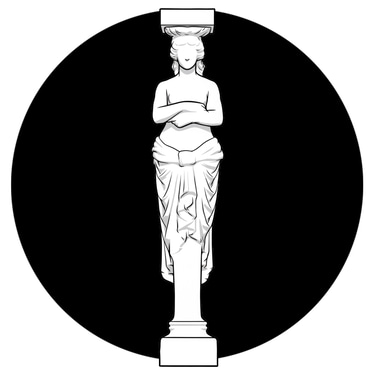
Vienna's finest streets are ornamented with bare-bosomed females, hard at work. They don't hold up traffic, but they do hold up banks and other buildings, where a column would otherwise have done the trick. Whereas their male counterparts, the atlantes, often groan visibly under the weight of the staterooms and salons, offices and emporia they support, these female powerhouses, called caryatids, are the very picture of feminine grace, bearing their Atlas-like burden with no sweat. What are nice dames like these doing in a job like that? Are they merely decorative, or is there something behind the façade?
The caryatids arrived en masse in Vienna as part of the Baroque retinue, and enjoyed a heyday in the 19th century revivals of historical architectural styles, of which Vienna is a veritable bastion. The columns, referred to as the 'orders, were the mainstay of classical architecture. Columns gave the measure to a building, which in essence was its relation to the proportions of an ideal human figure. To go, then, to the temples, as to the goddesses and gods in whose names they were erected, was to enter a monumentalized, an ideal, version of ourselves. Buildings, like deities, exhilarate us with a sense of our own expansive potential.
In The Dancing Column, the ultimate contemporary oeuvre on the orders, Joseph Rykwert explains that the orders themselves are ascribed genders. The mother and father of all columns, so to speak, are "the Ephesian Artemis for the Ionic genus, and Delphic Apollo for the Doric."1
The other orders (for example the slender, flowery Corinthian, evocative of the Kore or maiden) are the offspring of unresolved arguments (as so many Olympian offspring also were).
The assimilation of the male body to one kind of column, and the female to the other, will appear as a specific instance of the general metaphor.. It was one of the essential concepts around which architects would speculate and invent. The extension of the metaphor to three more orders ... depended (at least in part) on the disagreement about their exact detail.2
As such, the orders were a fundamental source of creative revision and invention in architecture.
The body metaphor was a working principle for building in Ancient Greece. So the question arises as to why there were not more caryatids in lieu of columns. In fact, caryatids are more abundant in Vienna than they were there. Rykwert speculates that since the body metaphor was self-evident, the actual use of the human form was too confining for the Greeks. The atlantes, the "Persians," and the "caryatids" may therefore all be read as illuminating instances of the one central analogy between column and body ... The fact remains that evidence about the nature of the interchange between and substitution o f figure and column i s rather scarce in Greek architecture... Indeed the explicit modeling of such figures may have been mistrusted by the Greeks as too anecdotal, perhaps too particular for the great generalities o f building. 3
In 19" century Vienna, the caryatids are reminders of the corporality of buildings, long after the body metaphor had lost its primacy for European architecture. (The crucified Corpus Christi was a model for cathedral construction, but the mortal body per s e was a cesspool of sin.) The Vienna caryatids provided a theme for creative variation. They assumed a variety of new poses, and made a fashion change from their forebears, letting their drapery slip t o reveal their torsos. One wonders how a straight-laced society reacted to the presence o f these lush, unashamed caryatid bellies and bosoms in the days before lingerie ads and strip joint placards. Even in Ancient Greece, the nude female statue was a rarity.4
Whereas the kouroi (boys) votive statues were always nude, the korai (maidens) were always draped. 5 In fact, nude females were altogether rare. Married women were not supposed to let their husbands unravel their togas even in bed. Their minds were to be kept in the dark as well.
Fast-forward from Grecian drapery to the chin-to-toe fashion o f 19th century Viennese ladies. In The World of Yesterday, Stefan Zweig gives an account o f his young aunt's terrified flight back to her parent's house on her wedding night because her husband had tried to take her clothes off.6 When my friend Sybille was growing up in Vienna of the 1950's (not an epoch noted for its hedonist sensuality), her view of the caryatids outside her window gave her sophistication beyond her years. Visiting schoolmates peered out the window as if they were at a peep show.
Exactly who and what the caryatids represented when they were first conceived in Ancient Greece remains a matter of speculation to this very day. So it tickles our fancy to ponder what they still might have to say to us, beyond their gracefulness. The less specific the associations, the more room for the private imagination, as the Greeks understood when they opted on the whole for the evocative powers of the columns over the human form.
That columns or the like could represent, i.e. speak for us, is in fact an ancient idea:
The planting of a post ... has always been seen as a metaphoric act ... It is also an act of taking possession of a ground ... because of the shadow that it casts, whose direction will always be parallel to that cast by my upright body. 7
But they also speak to us:
And of course fairy tales and legends are forever telling of posts that speak, warn, or even prophesy. ... Such an analogy seems already to have been familiar to megalithic builders, whose upright stones clearly allude to it. 8
The belief in articulate architecture found expression in the extreme in the utopian literature of the Renaissance, which postulated that a city could be "read" like a book. The culmination was the totalitarian walled city, decorated didactically with a moral mural. But the ultimate edification lay in imitation, i.e. in the copy. In Winckelmann's Reflections on the Reproduction of Greek Works of Art, a handbook for historicists, the philosopher expresses the sentiment that "The Beautiful", which to the Greek sensibility was synonymous with "The Good", reflects the moral perfection of humanity in the pure perfection of the work of art. Winckelmann claims that whoever attempts to comprehend the aesthetic philosophy of the Greeks, will also encounter their ethics, and therein the essence of all humanity. 9 Certainly there were edifying impulses at play in the revivals of antiquity to which Vienna is indebted for its abundant plasticity.
Is it the caryatids' comely proportions, or their serene balancing act, which is supposed to reflect a well-balanced, moderate nature? Perhaps they are ornaments to society, upholders of the virtues civic and family buildings are meant to house. You will often find caryatids supporting bay windows, those bosomy bulwarks of the Baroque, from which ladies could take part in or observe drawing room life, with one eye o n the life of the street. Inside, caryatids guard the hearth and hold up the mantel.
But there i s the indisputable fact of their unashamed female nudity. Are they maidens o r mothers, vestal virgins o r sexpots? Do they represent chastity or fertility? What do they mean? What do their attendant symbols tell us? Looking at them exactly, individualist as they are, the common quality i s that they combine bare-bosomed sensuality with priestess-like dignity. The idea of a sexy priestess seems bizarre, but there i s actually historical precedence for that intriguing synthesis. The caryatids hail from a tradition, which unified what we regard as contradictory spheres, namely the sexual and the spiritual.
The caryatids originated in the Orient. They appeared in Ancient Greek first at Delphi, then a t the Parthenon, specifically the Erechtheon, sometime between 420 and 410 BC. 10 The Erechtheon was built to honor Athena for conferring the olive tree and her protection o n the city of Athens, thus assuring its fertility and prosperity. How fitting that Vienna, where Athena rises up before the neoclassical Parliament, should become a city of caryatids.
In questioning the Roman historian Vitruvius' theory that caryatids represent the women of the town of Carya taken into slavery after siding with the Persians in a battle won by the Greeks, Rykwert postulates that they are more like the servants of the temple, but not servile: Yet even if it were quite legitimate to construe these figures a s temple "servants" similar t o the arrhephoroi, the virgin bearers o f wrapped, secret objects t o whom they are often compared and who are represented in a number of surviving antique statues, they are not oppressed slaves. These quasi-priestesses were lodged on the Acropolis of Athens (very near the Erechtheon) at state expense. heirs was an honorable role, not unlike that of the kanephorai, the bearers of holy baskets, who had an important part in the Eleusinian procession...11
A convincing etymological source for the caryatids is offered by Artemis, mother of the Ionic order: The hamlet Carya was in fact famous throughout Greece for something quite distinct from its disgrace in the Persian war: it was home to the cult of Artemis Karneia or Caryatis, whose main ritual was a stately dance of women devotees round a sacred nut tree. Indeed the term karuatisein, meaning 'to dance in a stately way', 'to do a round dance, was used as a common verb. Hesychius and Photius called the feast of the goddess 'karyteia'.12
These devotees are a particular instance o f the association o f caryatids and columns with the divine. In contemplating the oldest surviving monumental sculpture in Greece, the gate a t Mycenae with lions guarding a single column, Rykwert suggests: It may well be that the column on its double altar was a sign of the divinised city, guarded by its fierce protectors ... By extension, it suggests a more general question that cannot be answered directly: are not columns in some sense always the holiest part of a building.13
As priestesses, i.e. representatives, of goddesses, the caryatids in fact resonate symbolically with some 30,000 years o f human history. The Neolithic agricultural mother goddess was the supreme deity; the god was her consort and / or son. In the relatively recent culture of Ancient Greece, the Great Mother of all deities, Latona, took a back seat to Zeus. The goddesses were consorts and offspring of Zeus, with their own domains o f power, but Zeus had also co-opted their powers for himself. He also symbolized the role of man as supposed sole propagator of the species. Athena, for example, sprouted out of his head. At that time, it was believed that men's sperm produced children alone, the woman's body merely serving as a vessel. 14 (I mean, I skipped biology class a few times, too, but with less dire consequences for western civilization.)
Linda Davies suggested that another temple servant of whom caryatids could be evocative is the 'Sacred Prostitute'. Unlike profane prostitution, which, then as now, was exploitative and degrading, sacred prostitution was regarded as a holy office, a form o f service t o the goddess. The exact origins of sacred prostitution are as difficult to pin down a s that of the caryatids, but it was a tradition of sacred rite with different forms in many ancient societies, including Ancient Greece. In some societies, all young women were initiated by a stranger into sexuality before marriage, under the auspices of the goddess in her temple. In others, the sexual union o f the sacred prostitute, embodiment of the goddess, with the king, as embodiment of the god, was meant to assure the fecundity of the land. 15 In others still, given the constraints on women at the time, sacred prostitution was a career option considered by many women as preferable to marriage in terms of legal rights, freedom of movement, social status and education:
However they came to the temple of love, for a night or a lifetime, we know that the sacred prostitutes were many in number... They were accorded social status and were educated. I n some cases, they remained politically and legally equal to men. 16 Whatever its particular form, the practice signified an essential rite of passage for both men and women, a ceremony in which the sexual act was offered to and divinized by the goddess.
Man's and woman's sexual nature and their religious attitude were inseparable. In their praises of thanksgiving or in their supplications, they offered the sex act to the goddess revered for love and passion. It was an act, honorable and pious, pleasing to both the deity and mortal alike. The practice of sacred prostitution evolved within this matriarchal religious system and thus made n o separation between sexuality and spirituality.18
A man out for a mere bonk would have gone to a bordello. To go to the temple to unite with a sacred prostitute was a holy rite and a transforming experience: In her embodiment of the goddess, the sacred prostitute is the bringer of sexual joy and the vessel by which the raw animal instincts are transformed into love and love-making.19
As reflective of an attitude toward sex and the sacred, the historical figure of the sacred prostitute serves in Jungian psychology as an archetype. (One can, of course, view Jung's system either as a description of, or metaphor for, the human psyche.) Just as a photograph suggests one possible view of its subject, so a symbol presumably implies or evokes, rather than represents, an archetype. At these deep "layers" of the psyche, individual uniqueness gives way to autonomous functions, fields o f psychic energy, which become increasingly collective; that is, they are inherent in humankind throughout history. Jurg called this kind of psychic energy an archetype. What we mean by "archetype" is in itself irrepresentable ...20
The caryatids of Ancient Greece may not have lined the love goddess Aphrodite's temple, but in their Viennese incarnations, the caryatids lend dignity to sexuality. Their creators may have wanted to convey "objective" criteria for goodness and beauty. But whether they were chiselled t o imitate, edify, or titillate: like Pygmalion's statue, once complete, they had a spirit of their own. The caryatids are left t o work in the realm of fantasy, o r the unconscious. But just what kind of work are they meant to do? The messages the caryatids bear may not be the ones the sculptors had in mind.
In the Jungian scheme, the sacred prostitute is associated with creative transformation:
The highest phase of confrontation and individuation in both sexes is initiated by the feminine... The transformative, active side of the feminine principle accents the dynamic elements of the psyche that urge change and transformation. This active side of the feminine is similar to that divine madness of the soul described in Plato's Phaedrus, which invokes primeval forces that take us out of the limitations and conventions of social norms and the reasonable life. Eros in this sense produces ecstasy, a liberation from the conventions o f the group... Ecstasy may range from a momentary being taken out of oneself to a profound enlargement o f personality... I t i s this moving, changing transformative aspect of the feminine that is associated with the goddess o f love and with which the sacred prostitute is identified. 21
It so happens that the deities who represent transformation of the psyche, such as Dionysus, the generator of ecstatic experience,22 were accorded lonic temples, regardless of their sex. The genders of the temples corresponded to the character and function, rather than the sex, of the goddess or god.23 Athena, for example, had an Ionic temple as protector of the city, and a Doric temple as the virgin warrior.24 Temples for Mars and Herakles were also to have been built in the Doric style, for Aphrodite and Persephone in the maiden-like Corinthian, and for Hera, Artemis and Dionysus, the Ionic style.25 Dionysus was the father of the walnut nymph Carya, whose name was lent to the cult of Artemis Caryatis, mentioned earlier a s the probable root of the term 'caryatid'. Dionysus is said to have had a hand in agriculture, otherwise the sole domain of goddesses. Interestingly, he is often depicted a s hermaphroditic.26 He shared this quality with the Artemis cult: the maidens of Artemis, goddess of the animal wilderness, of girls on the eve of their weddings, and of mothers in childbirth, often attached phalluses to themselves for their ritual dances.27 Jung defined what he saw as the masculine principle in women as the animus, and the feminine in men as the anima:
In Jungian terms, the anima, which means soul in Latin, is the personification of the contrasexual side of a man's unconscious - his own inner feminine nature... She is the inner guide who leads the man through the labyrinth of the unconscious to the ultimate center of his being, the Self. This goddess is analogous t o the "opposite other", " the feminine element which together with the masculine comprises the totality of the Self. 28
Dionysus married Ariadne, whose thread symbolizes the feminine instinct that guided Theseus through the caves to slay the Minotaur. When Theseus unceremoniously dumped Ariadne, she went off with Dionysus, and presided over the initiation rite of girls into womanhood. Ariadne is also depicted as leader of the ecstatic dancing maenads, the women followers of Dionysus:
The dancing is not unlike the bacchanalian dance of the sacred prostitute. Plutarch explains that the dance was a madness filled with prophecy and secret knowledge. The dancing body enters into a ritual which connects the personal and the transpersonal; through erotic ecstacy the profundity of the spirit is realized. 29
Dionysus is - by dint of convoluted, incest-ridden, soap-opera like genealogy - quite literally at heart the son of Persephone, once removed. He was reborn to Semele and Zeus from the heart of the hunter Zagreos, offspring of Persephone's rape by Zeus, her father. 30 Persephone, or Kore (maiden), daughter of Demeter, goddess of the earth and its fertility, i s the ultimate symbol o f the anxiety- wrought, violent transition from girlhood to womanhood. Persephone's abduction to the underworld, where henceforth she wintered every year (and you think it's hot in Florida), could also be seen as symbolizing what we seek from art, as from love - an out-of-control plunge into the deep, unknown realms of our own unconscious, from whence we only ever partially return.
Vienna has its Athena, and its Demeters, Aphrodites, and Persephones. The Stock-im-Eisen Building, which introduces the Graben at the Kärtnerstrasse, is overseen by a large goddess-like figure protecting a mother with two children. She is accompanied by two caryatids, one with fruits of a bountiful harvest, the other with a mallet, a leather-bound book and a banner waiting to be unfurled: the earth mother gone revolutionary. The attendant rams' heads, which first figured in the art of early agrarian societies of Old Europe, represent animal sacrifice for agricultural fertility and prosperity. In fact, lonic column capitals are curled like a ram's horns, or braided hair.
Speaking of Demeter and the Horn of Plenty, at the gourmet temple Meinl am Graben, the caryatids employ all the coy tricks women use to display our figures to best advantage.31 To elongate the torso and raise their breasts to optimum pertness, they lift their arms gracefully to toy with their hair or prop up the entablature, their eyes chastely downcast. Like the untouchable young ladies of the Casanova Club down the street, accomplished artistes who topless toss, twirl and spin about in multiple hoops tastefully, there is nothing vulgar or "come- hither" about these representatives of Aphrodite. They invite us to rethink what we mean by 'virginal':
The virginal attribute of the goddess simply means she belongs to no man; rather she belongs to herself... The goddess of love behaved in accordance to her own divine laws of nature, free and unfettered by man-made laws.32
The girls at the Joop! store next door (who are very photogenic indeed), are maidens on the move, garlands streaming and robes aflutter. We see these Persephone/Kore figures here when they still flanked the appropriately named 'Gazelle' lingerie shop, before they had a paint job.
The goddess who was a girl - Kore - was also the column herself. She was the daughter of the Doric and lonic ways of building, and she was born when the Greeks required a new sign. 33
The body/ building metaphor was resonant in Europe until the 17th century, as is clear from this account the French court architect Chantelou gave of a conversation with the leading architect and sculptor of the age, Bernini: ...he told me that the beauty of everything in the world (and therefore of architecture also) consisted of proportion; which might almost be called the divine part in any thing, since it derived from Adam's body; that it had not only been made by God's own hand but also in His image and likeness; the variety of the orders arose from the difference between man's body and woman's - because of the differing proportions of each ...34
The erotic body has been villainized and lost its spiritual dimension for us long ago. The body as metaphor also lost its primacy i n architectural theory:
Le Brun's academic emphasis on the face as revealing the character, which reshaped the teaching of art the world over, took the power away from the body, and robbed the orders of their corporality.35 Since the hold of the (body) metaphor loosened at the end of the 17" century ... the rationale for using the orders was shaken, and ...proportional and dimensional structure had to be fixed into an arbitrary system of rules. The generative power of the orders therefore shrank and their hold turned into constriction. The accumulation of conflicting archaeological evidence only intensified the insecurity about them and strengthened the tyranny of the conventional rule.36
To borrow a Jungian metaphor, one could say that the transformative power of the orders to generate creativity, as a kind of anima of architecture, was diminished.
If you are inclined to think the body metaphor too abstract t o affect our contemporary sensibilities, or fear you are impervious to such sensations, I don't know about you, but I have wandered betimes down a city street, buoyant with a mind freshly unfettered, swerving spontaneously into unfamiliar territory to revel in a feeling of leisure. This coincides with a time of late afternoon when the light falls in such a way as to cast the buildings into bold, bodily relief. I can barely refrain from saying "Hey, boys!" to them with Mae West-like swagger, winking suggestively. I suddenly experience the sensation of moving through some erotic medium, with the bemused feeling that instead o f just going to buy dental floss, I had done something delightfully naughty, and return home stirred to perform some creative act.
The painter Poussin seems to have had kindred experiences. In a wistful letter to Chantalou, he imagines:
...that the beautiful girls which you saw at Nimes will have given your spirit no less delight through the eyes ... than the beautiful columns o f the Maison Caree - since the second are merely aged copies of the first. I find it a matter of great satisfaction to get such a break during our labors which sweetens the exertion. 37
Is there anything left of the goddess' powers in their representatives in Vienna?
Recalling that goddesses and gods are potentialities available to every human being, it would seem that the myth of Athena explores above all the quality of reflection...38
The descendants o f Athena's attendants are reflected through the eye of the portraitist. The click of the shutter brings out the soul in the stone, releasing the individual i n the archetype. Brought down off their shelf, they evoke the archetypal potential in each individual.
Stone has become a metaphor for all that i s unfeeling, yet the concepts of "stone" and "soul" are not as antithetical as they may seem. If you have ever wondered what impelled people of Megalithic cultures to haul and erect the massive stones of shrines like Stonehenge and hundreds of similar sacred formations:
The stone, which lasts s o long it seems timeless, offers a n image o f a reality that survives the passing of time. The stone symbolized the essential being: the soul or spirit of animate life that was not subject t o decay, but endured beyond and beneath all appearances. The menhirs, or standing stones, were believed to be the 'dwelling' or 'body' of the dead, whose souls, when summoned, would 'inhabit' the stone erected to receive them. 39
These sacred sites were all dedicated without exception to the Great Mother.
At the end of the era of the caryatid, which metamorphosed into the reliefs and mosaics of Jugendstil, the birth of modernism was heralded by a young messenger goddess from the New World named Isadora Duncan, who rushed through Europe like a mobilized Statue o f Liberty t o free the Old World from the constraints of the corseted body and spirit, to barefoot bring the sylph back down to the ground. Ancient Greece was her inspiration. When Isadora trampled the stages of Vienna in 1905, the architects and artists of Jugendstil and the Secession flocked to seek inspiration in her powerful free-flowing forms. The Secession and Jugendstil were the first creative movements after a long period of historic mimesis, arising from the urge to create a new style of the time. Legend has it that Isadora once bared her bosom and said, "This is art." A gentleman in the audience stood up and said, "No, dear lady, that is Nature."
Perhaps meeting the caryatids now, off their pedestals, face to face, you can feel the thrill of a n ancient nature - our own - billowing through their robes, these messengers to the city of Vienna.
Dr. Diane Shooman 2004
1 *Joseph Rykwert, The Dancing Column: On Order in Architecture (Cambridge, MA: The MIT Press, 1996),p. 249.
2 Ibid., p. 122.
3 Ibid., p. 138.
4 Ibid., p. 110
5 Ibid., p. 115
6 Stefan Zweig. Die Welt von Gestern: Erinnerungen eines Europäers (Frankfurt: Fischer Taschenbuch Verlag, 2001), p. 98.
7 Rykwert, p . 138.
8 Ibid., p . 138.
9 Johann Joachim Winckelmann, Gedanken über die Nachahmung der Griechischen Werke, 1755.
10 Rykwert, p . 135.
11 Ibid., p. 135
12 Ibid., p. 135
13 Ibid., p . 153
14 Nancy Qualls-Corbett, The Sacred Prostitute: Eternal Aspect o f the Feminine (Toronto: Inner City Books. 1988), p . 41.
15 Ibid., p. 79.
16 Ibid., p. 37.
17 A definition of matriarchy may be of use: Matriarchy here does not simply mean that women replaced men in authority positions, rather, the focus was on different cultural values: Where patriarchy establishes law. matriarchy establishes custom; where patriarchy establishes military power, matriarchy establishes religious authority; where patriarchy encourages the aresteia of the individual warrior, matriarchy encourages the tradition- bound cohesion of the collective. Matriarchy was concerned with cultural authority a s opposed to the political Power emphasized by the patriarchy." (Ibid., p . 30.)
18 Ibid., p. 31.
19 Ibid., p. 34
20Ibid., p . 54.
21 Ibid., pp. 36-57
22 Rykwert, p. 337.
23 Rykwert. p. 237.
24 Ibid. p. 239
25 Ibid.. p. 237.
26 Ibid., p. 237.
27 Anne Baring and Jules Cashford, The Myth of the Goddess: Evolution o f an Image (London: Penguin Books. 1993), p. 326
28 Oualls-Corbett. p. 66.
29 Ibid., p. 70.
30 Rykwert, p. 337.
31 Lovely as they are, they proved to b e unphotogenic. It happens to the best of us.
32 Qualls-Corbett, p. 59:
33 Rykwert, p . 338.
34 Ibid., pp. 29-30.
35 Ibid.. pp. 45-46.
36 Ibid., p. 122.
37 Ibid.. p . 30.
38 Baring and Cashford. p. 345.
- We are grateful to Dr Diane Shooman for her gracious permission to reproduce this essay on our website.
Contact
info@centralcasting.at
© 2025. All rights reserved. Patent pending.